THE INTERNAL ARTS
Qigong, Neigong & Neidan.
Different terms are often used to describe different layers of internal practice. While each has its own meaning and history, the boundaries between them are not always as clear-cut as modern classifications can suggest.
At Following the Moon, the emphasis is less on categorisation and more on understanding how these practices relate — and, most importantly, experiencing them through practice.
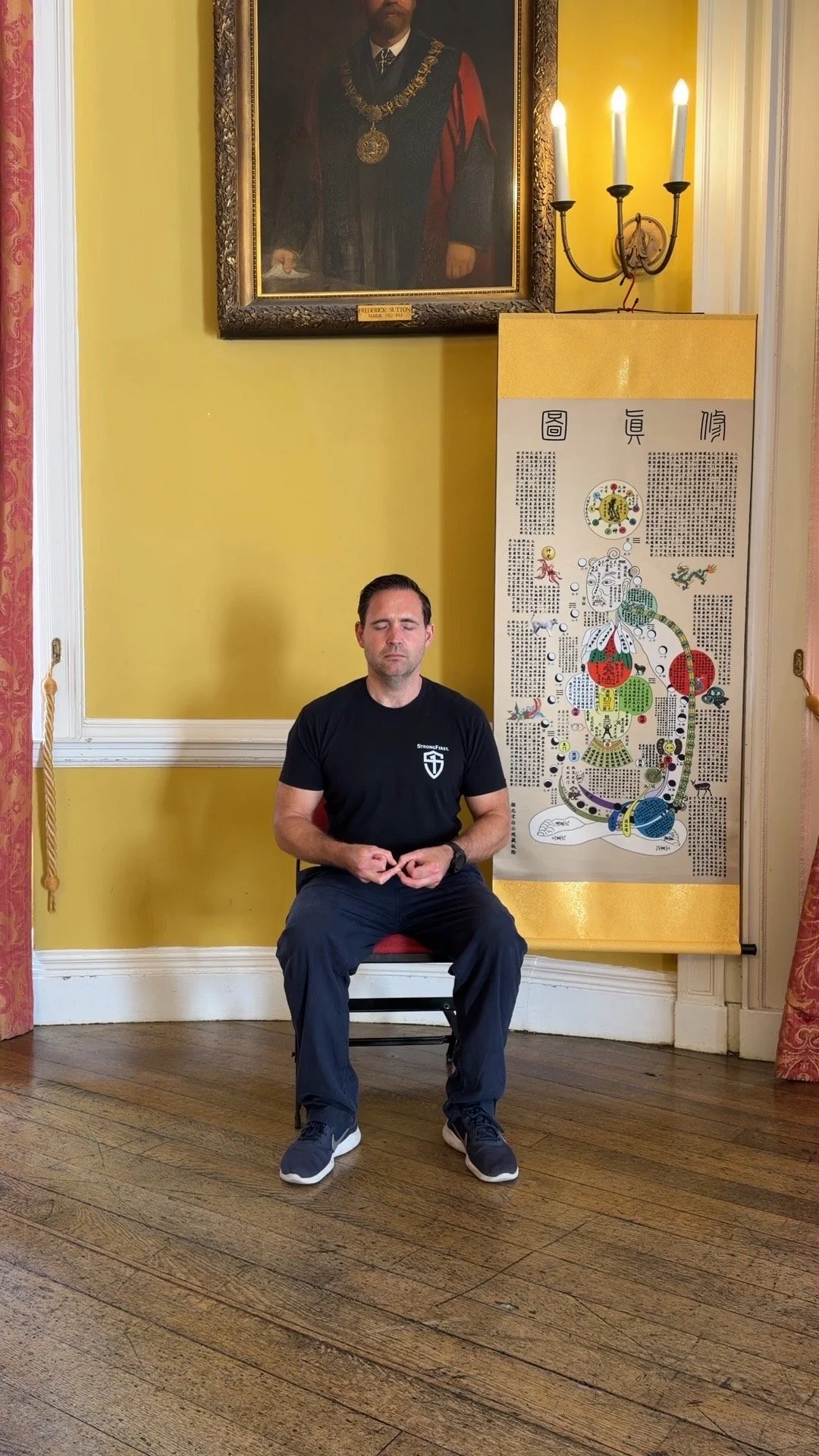
WHAT IS QIGONG?
Working with Qi.
Qigong (氣功) is commonly translated as “energy work” or “skill cultivated through working with Qi”. Today the term covers a vast range of practices involving movement, posture, breath, attention, meditation and internal cultivation.
Although the practices themselves can be traced through much older Chinese traditions, Qigong is actually a relatively modern umbrella term. Many of the methods we now place under the Qigong banner existed long before they were collectively described this way.
Some practices are primarily concerned with health, movement and relaxation; others go considerably deeper into internal awareness, structure, breath, intention and energetic cultivation. This is one reason defining Qigong as simply a form of gentle exercise misses much of what the wider tradition contains.
At Following the Moon, I use Qigong in this broader sense — as an umbrella term for a spectrum of internal practices rather than one particular style or form.
WHAT IS NEIGONG?
The work within.
Neigong (內功) is commonly translated as “internal work” or “internal skill”. Where Qigong may describe the wider field of practice, Neigong often refers more specifically to the internal processes and qualities being developed through that practice.
Rather than simply focusing on the external shape of a movement or posture, Neigong turns attention inward — exploring structure, relaxation, breath, awareness, intention and the internal connections that gradually develop through consistent training.
This can include learning to release unnecessary muscular tension, developing greater sensitivity within the body, coordinating movement from the centre, working with Yi (intention/attention) and becoming increasingly aware of Qi and the subtler changes occurring during practice.
The movement may look simple from the outside. The real work is often happening within.

WHAT IS NEIDAN?
Internal alchemy.
Neidan (內丹) is commonly translated as “internal alchemy”. It developed within Daoist traditions as a system of inner cultivation concerned with transformation rather than simply physical movement or exercise.
Neidan practices traditionally work with concepts such as Jing, Qi and Shen — often translated as essence, energy and spirit — alongside breath, awareness, stillness and meditation. Different Daoist traditions describe the methods and stages in different ways, so Neidan is better understood as a broad family of internal cultivation traditions rather than one single technique.
Compared with much of what is commonly called Qigong today, Neidan generally turns the practice further inward. Movement may become less important while stillness, awareness and increasingly subtle aspects of internal practice take greater emphasis.
If Qigong can be thought of as working with the practice, and Neigong as developing the work within, Neidan takes us further into the process of inner cultivation and transformation.
THE INTERNAL ARTS
Different names. One continuum of practice.
Qigong, Neigong and Neidan are useful terms, but in practice the boundaries between them are not always clear-cut. Different traditions, teachers and lineages may use the words differently, and a single system can contain elements that could reasonably be described by all three.
A Qigong form may begin with movement, posture and breath, yet with deeper practice develop internal structure, awareness, intention and Qi — qualities often associated with Neigong. As the work becomes increasingly subtle and contemplative, it may also begin to overlap with territory traditionally associated with Neidan.
For this reason, I don't see them as three completely separate practices or as a rigid progression from one to the next. They are better understood as different ways of describing aspects and depths of internal cultivation.
At Following the Moon, I often use Qigong as the umbrella term for this wider field of practice — encompassing movement, stillness, breath, meditation, internal work and energetic cultivation.
The terminology can help us understand the practice. The practice itself is what matters.
THE PRACTICE
Understanding is useful. Practice changes things.
Qigong, Neigong and Neidan can be studied, discussed and categorised endlessly, but ultimately they are experiential practices.
We develop through doing — standing, moving, breathing, observing and becoming increasingly sensitive to what is happening within us. Over time, things that may initially feel subtle or unfamiliar can become clearer as awareness, coordination and sensitivity develop.
Meditation and breathwork naturally sit alongside this process. Movement can lead towards stillness, breath can become a bridge between body and mind, and meditation allows us to explore awareness without the constant need to do or change something.
For me, the theory provides context and direction, but it should always lead us back to practice.
Less thinking. More practice.
EXPERIENCE THE PRACTICE
The next step is practice.
Qigong, Neigong and Neidan can be studied, discussed and categorised endlessly, but ultimately they are experiential practices.
We develop through doing — standing, moving, breathing, observing and becoming increasingly sensitive to what is happening within us. Over time, things that may initially feel subtle or unfamiliar can become clearer as awareness, coordination and sensitivity develop.
Meditation and breathwork naturally sit alongside this process. Movement can lead towards stillness, breath can become a bridge between body and mind, and meditation allows us to explore awareness without the constant need to do or change something.
For me, the theory provides context and direction, but it should always lead us back to practice.